
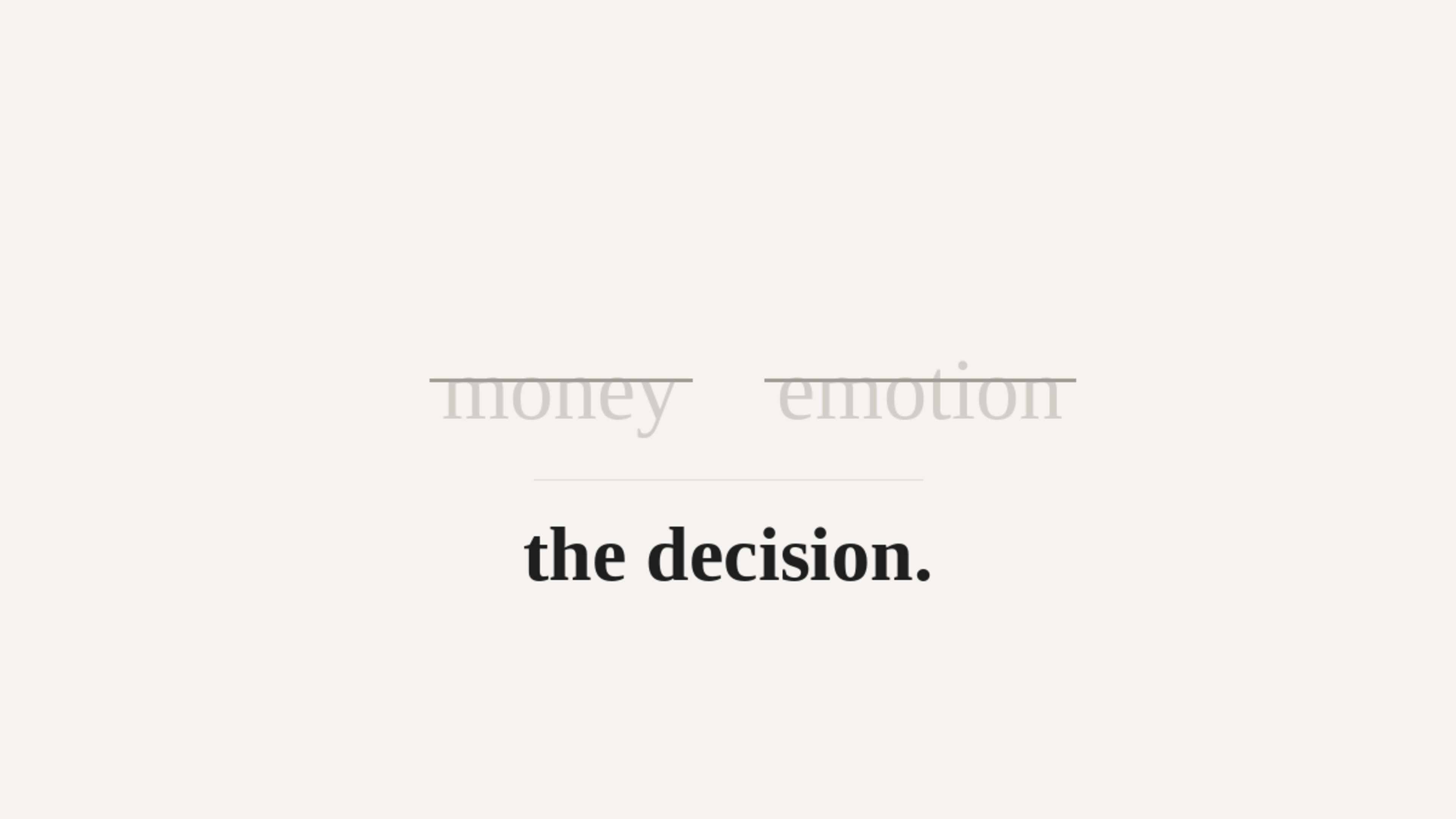
Strip It Down: Take Money and Emotion Off the Table
The short answer
Take money off the table, then take emotion off the table, and ask what the right call is. Most of the time the answer is obvious in minutes, because money and emotion were distorting the signal. I once held a company ten months after I knew it was dead.
A man comes to me with a decision he cannot make. He has been sitting on it for weeks or months. He has run the numbers, talked to advisors, lost sleep, and he is still stuck. The decision feels enormous, almost impossibly weighted.
The first thing I do is strip it down.
Here is the process. Take money off the table. Not permanently. Just for the purpose of seeing the decision clearly. If money were not a factor, what would you do? The answer usually comes fast, because the man already knows what the right call is. He has known for a while. The money is sitting on top of the decision like a weight on a lid, and the weight makes it impossible to see what is underneath.
Then take emotion off the table. Fear of failure. Fear of what people will think. The sunk cost of what you have already invested. The identity you have wrapped around the current path. Strip all of that away and ask the question again: without the emotion, what is the right call?
Most of the time, once money and emotion are removed, the decision is obvious. The man can see it clearly in under five minutes. The reason he could not see it before is that the money and the emotion were doing what they always do: distorting the signal.
The mechanism underneath this is worth understanding. Money distorts decisions because it converts every option into a risk calculation. "If I do X, I might lose Y." The risk calculation is real, but it is not the decision. The decision is "what is right for the business, the customer, and me?" Once you answer that, you can manage the money. The money is a constraint, not a compass.
Emotion distorts decisions because it hijacks the reasoning process. Fear of failure makes a man hold on to a business he should have closed eight months ago. Pride makes a man keep a strategy that is not working because changing course feels like admitting he was wrong. Love for what he built makes a man keep a team that is too large because cutting people feels like betrayal. None of those emotions are wrong. They are real and they matter. But they are not the decision.
I have used this framework on myself more times than I can count. The hardest one: I knew a company was dead at eight months and held on to it until month eighteen. I did not grind the business into the ground. I ground myself into the ground. Money was recoverable. Time and energy were not. If I had stripped the money and the emotion off that call at month eight, I would have saved myself ten months of pain.
The teaching is this: say it out loud to the right people. Strip the money. Strip the emotion. See the actual decision. Then make it and own it. The hard part is not the decision. The hard part is admitting that you have been sitting on a clear answer because the money or the emotion made it feel bigger than it is.
What decision have you been sitting on that you already know the answer to?
~b