
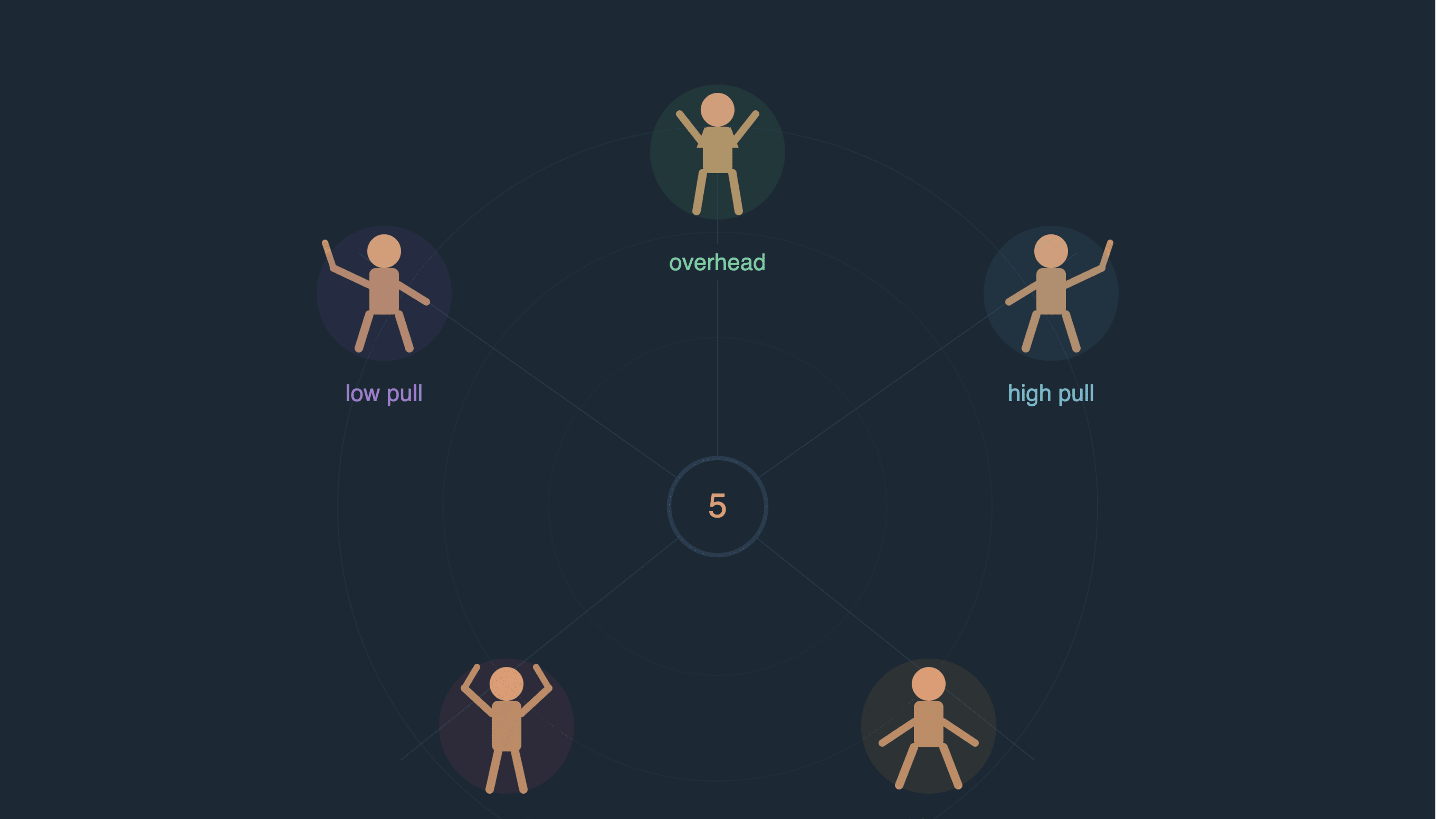
The Five Angles: How to Pick Five Exercises for Any Body Part
The short answer
Most lifters pick the movements that feel good, so some angles get neglected and the body plateaus or starts to hurt. When you pick five exercises for a body part, think in angles. For back: overhand pulldown, neutral-grip pulldown, face pull, row, and pullover. Coverage is the goal; five is the guide.
The men I coach who train consistently almost always have a program. They know their exercises, they know their rep ranges, they show up and do the work. The problem I see most often is not effort. It is selection.
Most lifters pick exercises they are good at. The bench press feels good, the lat pulldown feels productive, the curl is satisfying. So the program gravitates toward the movements that provide the best feedback, and the angles that are harder or less satisfying get neglected. Over months and years, the result is a body that is overdeveloped in certain directions and underdeveloped in others. The imbalance shows up as a plateau, or as a nagging joint issue, or as a shape that looks strong from one angle and flat from another.
The framework I teach is called the Five Angles. It is a coaching lens for exercise selection, not a formula. When picking five exercises for a body part, think in angles.
Take your back day. The back is a complex muscle group that responds to being pulled from different directions. A vertical pull with an overhand grip works the lats from above. A vertical pull with a neutral or underhand grip shifts emphasis toward the biceps and the inner back. A high horizontal pull, like a face pull, hits the rear delts and upper back. A standard rowing movement targets the mid-back and rhomboids. And a pullover or straight-arm pulldown works the lats through extension rather than flexion. Five angles, five different stimuli, one complete back session.
The same logic applies to chest: flat press, incline press, decline or dip, fly movement, and a specialty variation like a floor press or close-grip. To shoulders: overhead press, lateral raise, front raise, rear delt work, and a rotational stabilizer movement. To legs: a quad isolation warm-up, a hamstring isolation warm-up, a compound press or squat, a glute hinge like an RDL, and calves or lateral work to finish.
The teaching is not that you must hit exactly five angles every session. Two exercises can share an angle and the session still works, as long as the rest of the selection covers the angles that would otherwise be missed. Coverage is the goal. The angle count is the heuristic that gets you there.
The practical application for the men I coach is that the Five Angles removes the guesswork from program design. Instead of asking "what exercises should I do," the question becomes "which angles have I covered and which am I missing?" That question is easier to answer, and it produces better programs than picking movements by preference or habit.
Variety is what makes the body strong. The Five Angles is how you make variety systematic rather than random.
When you look at your current program, which angle are you skipping?
~b