
The quiet schoolteacher
The short answer
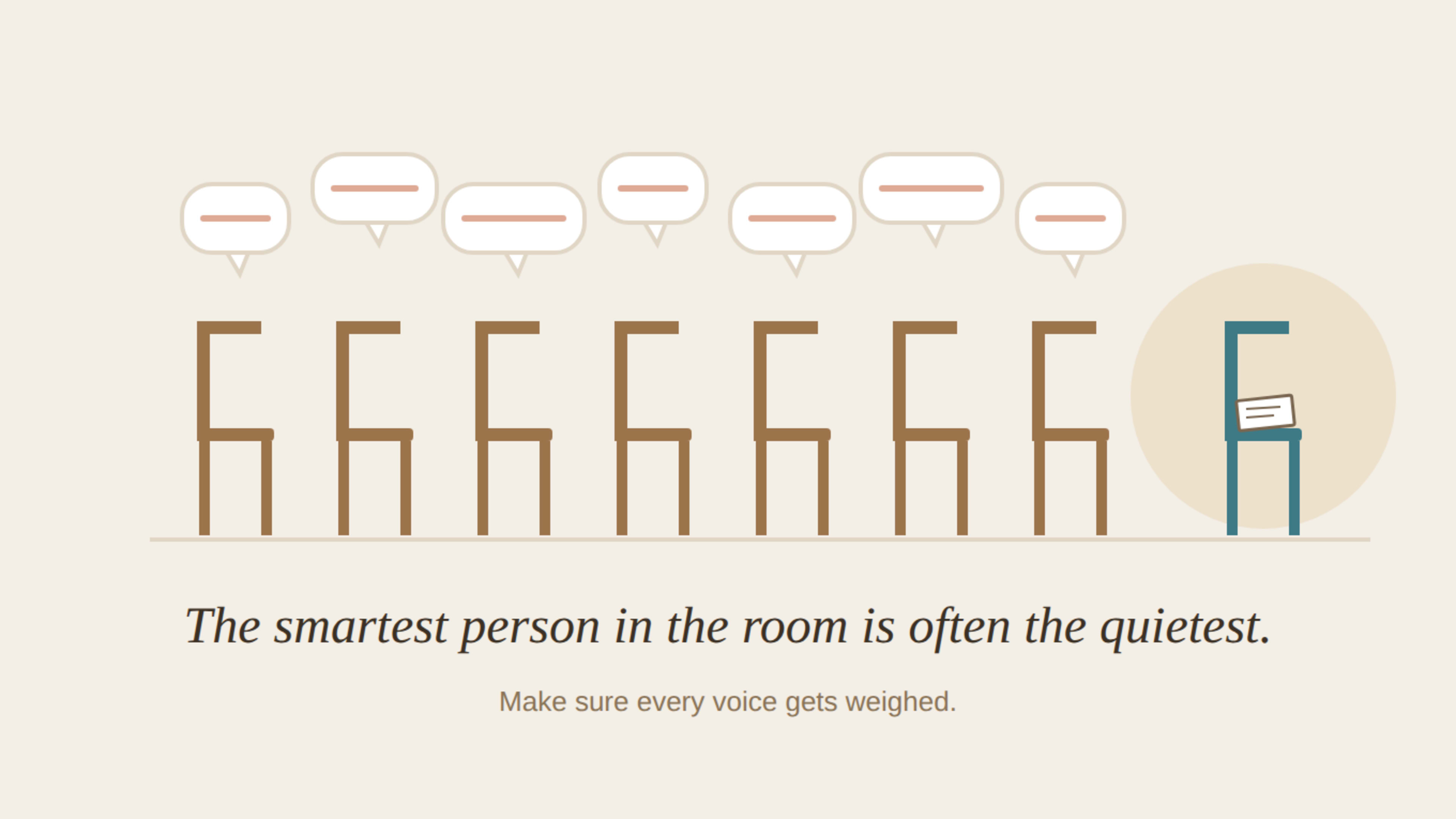
The smartest person in the room is often the quietest. As jury foreman, Bill broke a two-day deadlock by calling on the one juror who hadn't spoken, and she spotted evidence everyone else missed. A leader's job is to make sure every voice gets weighed, and AI now makes it easier to gather them before the meeting.
I was the foreman on a jury, and we were stuck. Two days of deliberation, the same arguments going around the table, the same people making them. Nobody was moving.
So I stopped listening to the arguments for a minute and looked at the room. One juror, a schoolteacher sitting toward the back, hadn't said a single word in two days.
I called on her. "You haven't spoken up."
"Well, thank you for asking," she said. Then she laid out, clearly and calmly, exactly why she saw the case the way she did. She pointed to one specific moment in the video evidence that none of us had focused on. We went back and watched it again.
"Never saw that. You're right." The verdict changed.
Had I never called on her, we wouldn't have known.
Why did it take two days to hear her?
Because the conversation followed the people who were talking. They were sure of themselves, they kept making their case, and the room organized itself around them. She had the most important observation of all, and she was waiting to be asked.
The same thing happens in business meetings. A quiet person can sit on the one insight that changes the decision, and the meeting ends without it unless somebody goes and gets it. Speaking up in front of a room of confident colleagues is hard for a lot of capable people, and the decision pays for that silence.
The lesson I took out of that jury room: the smartest person in the room is often the quietest. The loudest voice doesn't run the room. The foreman does. Your job is to make sure every voice gets weighed.
What does the foreman's job look like in a business?
If you lead anything, you are the foreman. That makes it your job to notice who hasn't spoken, and to make room for them without putting them on the spot in a way that shuts them down further.
Sometimes that's as simple as what I did: look around, see who's been silent, and ask directly. "You haven't said anything. What are you seeing?" Asked with real curiosity, that question opens doors.
But a meeting is still a hard place for a quiet person. They are being asked to perform, in real time, in front of their peers, often while nervous. So I've changed how I gather opinions in the first place.
How do you hear the quiet voices before the meeting starts?
I now use AI to collect every team member's view outside the meeting. Each person gives their input in their own words, in their own comfortable environment, anonymously if that's what it takes for them to be honest. The AI collates all of it before we ever sit down together.
When the room convenes, the quiet person's thinking is already on the table, weighted the same as everyone else's. Nobody had to raise their voice over eight colleagues to get there. The schoolteacher gets heard every time.
This is the same principle I write about in thought partner, not thought leader: AI does the gathering and the sorting so the human judgment at the end is better informed. Here, the judgment gets better because more of your people are actually in it.
It also changes the culture. When people see that their input is collected and used whether or not they speak up in the moment, they start contributing more. The team learns that their thinking counts.
I'll never forget that schoolteacher. Two days of argument, and the answer was sitting in the back row the whole time, waiting for someone to ask.
Who in your last meeting didn't say a word, and what do you think they saw that you missed?
~b